
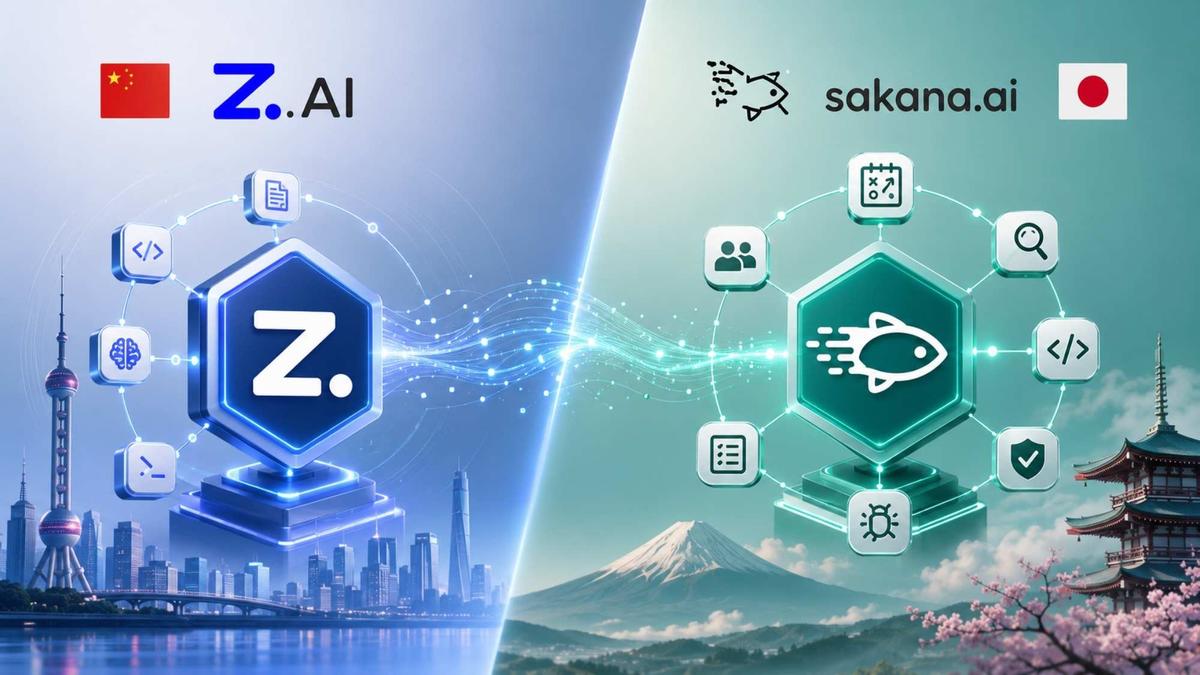
Two new AI model launches are pointing at the same problem from opposite directions.
GLM-5.2 wants to make one model good enough to understand an entire engineering project, hold a massive long-context window, and keep working through complex coding tasks without losing the plot.
Sakana Fugu takes a different path. It wraps multiple models and agents behind one OpenAI-compatible API, using learned orchestration to decide which agent should think, work, verify, or revise.
That makes this more than a model comparison.
It is a preview of where AI coding agents are going in 2026: bigger context windows, smarter orchestration layers, and more pressure on developers, founders, and technical teams to understand which architecture actually fits the job.
The simple version:
GLM-5.2 is the coding brain. Sakana Fugu is the orchestration layer.
If you need one model to hold a huge codebase in context and work through long-horizon engineering tasks, GLM-5.2 is the more natural fit.
If you need a system that coordinates multiple models, delegates roles, and verifies harder work, Sakana Fugu is the more interesting bet.
Quick Verdict: GLM-5.2 vs Sakana Fugu
Full-codebase understanding
Best fit: GLM-5.2
Why: Built around long-context coding and project-scale engineering workflows.
Long-horizon refactoring
Best fit: GLM-5.2
Why: Strong fit for multi-file, multi-step code changes with constraints.
Multi-agent orchestration
Best fit: Sakana Fugu
Why: Designed to coordinate multiple models and agents behind one API.
Fast OpenAI-compatible API testing
Best fit: Sakana Fugu
Why: Exposes Fugu and Fugu Ultra through an OpenAI-compatible API.
Compliance-sensitive model routing
Best fit: Sakana Fugu
Why: Fugu allows opt-outs from specific model providers or agents.
Open-model experimentation
Best fit: GLM-5.2
Why: Better fit for teams evaluating model-level control and deployment options.
Research reproduction
Best fit: Both
Why: GLM-5.2 fits codebase-level reproduction. Fugu Ultra fits quality-first agentic research.
Coding-agent tooling
Best fit: GLM-5.2
Why: Strong candidate for tools like Claude Code-style workflows, Cline, Codex-style agents, or OpenHands-style setups.
One best AI coding model searches
Best fit: GLM-5.2
Why: Easier to evaluate as a standalone coding LLM.
Best AI coding agent system searches
Best fit: Sakana Fugu
Why: Stronger story as a coordinated multi-agent system.
Here is the practical takeaway:
Pick GLM-5.2 when the job depends on deep project context. Pick Sakana Fugu when the job depends on orchestration, verification, and multiple agents working together.
What Is GLM-5.2?
GLM-5.2 is Z.AI’s flagship model for long-horizon tasks, especially coding.
The big headline is its 1M-token context window. But the better story is not just “more tokens.” The better story is whether the model can actually use that context without falling apart halfway through the task.
That matters because real software work is not a single prompt.
A real coding agent may need to understand:
- The repository structure
- Backend and frontend boundaries
- API contracts
- Testing requirements
- Build commands
- Deployment constraints
- Product requirements
- Existing technical debt
- Team conventions
- Previous decisions made earlier in the session
A smaller or weaker-context model might read part of the repo, make a decent first change, and then forget the original constraints three steps later.
GLM-5.2 is built for the opposite behavior: hold more of the project in context, preserve engineering decisions across a longer chain of work, and complete more of the development workflow from requirements to deployable output.
That makes it especially interesting for developers testing AI coding agents in real repositories.
Why GLM-5.2 Matters for AI Coding Agents
The market already has plenty of AI code generators.
That is not the same thing as an AI coding agent.
An AI code generator writes snippets. An AI coding agent needs to reason through the actual work: read files, understand dependencies, plan changes, edit code, run tests, fix errors, and explain what changed.
That is why long-context LLMs matter.
The bottleneck in AI coding is not always “Can the model write a React component?” Most frontier models can do that.
The harder questions are:
- Can the model understand why the component exists?
- Can it avoid breaking the API contract?
- Can it follow the team’s architecture?
- Can it touch five files without making a mess?
- Can it run the test suite and interpret failures?
- Can it remember the refactor boundary from 30 minutes ago?
That is where GLM-5.2’s positioning gets interesting. It is not just trying to be another chatbot that writes code. It is trying to be the model that can sit inside a long-running coding workflow and keep the project in its head.
For technical founders, that matters because most AI coding tools look amazing in demos and messy in production. The moment you move from greenfield toy apps to real codebases, context becomes everything.
Best GLM-5.2 Use Cases
GLM-5.2 is worth testing when you need one model to reason across a large, messy, real-world project.
The best use cases include:
- Project-level codebase audits
- Monorepo understanding
- Long-horizon refactoring
- API migrations
- Cross-file debugging
- SDK adaptation
- Test repair
- Production-readiness reviews
- Mobile or client-side debugging loops
- Research paper reproduction
- Code-to-video workflows using frameworks like Remotion
The strongest use case is probably the least flashy one: taking an existing business codebase and asking the model to map the system before touching anything.
That is where a serious coding agent should start.
Before it writes code, it should understand:
- Core modules
- Data flows
- API contracts
- Directory structure
- Known risks
- Testing requirements
- Constraints it should not violate
That kind of behavior is more valuable than a model that immediately generates a bunch of code and then leaves the developer to clean up the wreckage.
What Is Sakana Fugu?
Sakana Fugu is not just another single model release.
It is a multi-agent system delivered as one model-like API.
That distinction matters.
With a normal LLM API, you call one model. With Fugu, you call an API that can coordinate a pool of models and agents behind the scenes.
Sakana describes Fugu as a system that dynamically orchestrates multiple models for complex, multi-step tasks. Instead of forcing the user to hand-design a workflow, assign roles, and decide which model should do what, Fugu tries to learn the coordination pattern itself.
In plain English:
Fugu is trying to make multi-agent systems usable without making every developer become a workflow architect.
Sakana Fugu Versions
Fugu
Best for: Everyday coding, reasoning, and responsive workflows.
Tradeoff: Balanced performance and latency.
Fugu Ultra
Best for: Harder, higher-stakes, quality-first tasks.
Tradeoff: More expensive or heavier multi-agent coordination.
Fugu is the default choice when you want strong performance with lower latency.
Fugu Ultra is the one you test when quality matters more than speed: research, cybersecurity analysis, paper reproduction, patent investigation, Kaggle-style workflows, and complex coding tasks.
Why Sakana Fugu Matters for Multi-Agent Systems
Multi-agent systems have been one of the most hyped ideas in AI.
The pitch is simple: instead of asking one model to do everything, create a team of agents. One agent plans. One writes. One checks. One critiques. One verifies. One revises.
The problem is that most multi-agent systems are brittle.
They can become over-engineered fast. You end up designing roles, prompts, routing logic, retries, verification loops, and cost controls. Sometimes the agent team performs better. Sometimes it just burns tokens while arguing with itself.
That is why Fugu is interesting.
It is not just saying, “Here are agents.” It is saying the orchestration layer itself should be learned.
Sakana’s research direction is based on systems like TRINITY and Conductor, which explore how models can coordinate teams of agents, assign roles, and discover better collaboration patterns.
That turns orchestration into the product.
For developers, that means you may not need to manually build a Thinker, Worker, Verifier, and Judge stack yourself. You call one API, and the system decides how to allocate the work.
For business teams, that is a very different AI infrastructure bet.
You are not just buying access to one smart model. You are buying a coordination layer that can potentially route across different expert models depending on the task.
GLM-5.2 vs Sakana Fugu: One Big Brain vs Many Coordinated Agents
The easiest way to understand this comparison is architecture.
GLM-5.2 is the “one big brain” approach.
It asks: what if one model had enough usable context and coding ability to understand the whole project and keep moving through a long task?
Sakana Fugu is the “many coordinated agents” approach.
It asks: what if the best result comes from coordinating multiple models, assigning roles, and verifying work through a learned orchestration process?
Neither approach is obviously “right” for every task.
They solve different failure modes.
GLM-5.2 is trying to solve context fragmentation.
Fugu is trying to solve coordination and verification.
That distinction matters because AI coding fails in different ways.
Sometimes the model fails because it cannot see enough of the project.
Sometimes it fails because it sees the project but does not verify its own work.
Sometimes it generates the right code in the wrong file.
Sometimes it solves the first half of the task and forgets the second half.
Sometimes it needs a planner, a coder, and a critic, not one generic assistant.
The future of AI coding probably includes both paths.
A long-context coding model can act as the agent’s brain. A multi-agent system can act as the routing and verification layer. The winning stack may not be GLM-5.2 or Fugu. It may be GLM-style long-context models inside Fugu-style orchestration systems.
Benchmark Comparison: What Should Developers Actually Look At?
Benchmarks are useful, but they are not the whole story.
For AI coding agents, the best benchmarks are the ones that get closer to real engineering work. A model that does well on short coding puzzles may still fail when it has to modify a real repository, preserve constraints, run tests, and debug its own mistakes.
Benchmarks Worth Watching in 2026
SWE-bench Pro
Link: https://www.swebench.com/
What it tests: Real software engineering issue resolution.
Why it matters: Better proxy for practical coding-agent work.
Terminal-Bench 2.1
Link: https://www.tbench.ai/
What it tests: Command-line task execution.
Why it matters: Useful for agents that operate inside dev environments.
FrontierSWE
What it tests: Long-horizon engineering tasks.
Why it matters: Helpful for evaluating complex software work.
SWE-Marathon
What it tests: Sustained software engineering performance.
Why it matters: Useful for testing whether models stay coherent over longer tasks.
LiveCodeBench
What it tests: Coding and programming ability.
Why it matters: Still useful, but not enough by itself.
SciCode
What it tests: Scientific coding and reasoning.
Why it matters: Relevant for research-heavy workflows.
Long Context Reasoning
What it tests: Long-context comprehension.
Why it matters: Important for repo-scale and document-heavy workflows.
Based on the published positioning from each company, GLM-5.2 is stronger as a standalone long-context coding model story, while Fugu is stronger as a system-level orchestration story.
That means the right benchmark question is different for each.
For GLM-5.2, ask:
Can this model understand my codebase and complete a long-running task without drifting?
For Fugu, ask:
Does this orchestration system produce a better answer than one model would on its own?
Those are not the same test.
When GLM-5.2 Is the Better Choice
GLM-5.2 is the better starting point when the task needs deep context more than multi-agent coordination.
Use GLM-5.2 when you want to:
- Analyze a full repository
- Refactor a large codebase
- Keep architectural constraints in memory
- Run multi-step coding tasks
- Work across frontend, backend, tests, and docs
- Use a model inside coding-agent tools
- Evaluate an open-model coding option
- Test long-context software engineering workflows
For example, imagine a founder with a messy SaaS codebase.
The app works, but the repo has grown quickly. There are duplicate components, inconsistent API patterns, a few risky dependencies, and tests that nobody trusts.
A basic AI code generator might help write one function.
A long-context model like GLM-5.2 is more interesting because you can ask it to inspect the whole project, map the architecture, identify technical debt, propose a refactor boundary, make the change, run tests, and report what it touched.
That is the type of work where long-context coding becomes valuable.
The model is not just generating code. It is helping preserve continuity across the engineering task.
When Sakana Fugu Is the Better Choice
Sakana Fugu is the better starting point when the task benefits from multiple agents, role specialization, or verification.
Use Fugu when you want to:
- Coordinate multiple models through one API
- Run complex reasoning workflows
- Add verifier-style behavior to tasks
- Improve reliability on hard, multi-step problems
- Experiment with multi-agent systems without hand-building the entire stack
- Route work across different model strengths
- Use OpenAI-compatible API patterns
- Control participation from certain models or providers
Fugu Ultra is especially interesting for tasks where quality matters more than speed.
Think about research reproduction, cybersecurity analysis, difficult debugging, literature review, patent investigation, or complex coding work where the first answer is often wrong.
In those cases, you may not want one model to confidently produce an answer. You may want a system that can plan, execute, challenge, verify, and revise.
That is the promise of Fugu.
It treats collaboration between agents as the core product, not as something the developer has to glue together manually.
Long Context LLMs vs Multi-Agent Systems
The GLM-5.2 vs Fugu comparison is really part of a bigger question:
Should AI systems get better by giving one model more context, or by coordinating multiple models more intelligently?
A long context LLM gives one model a bigger working memory.
A multi-agent system gives the workflow more structure.
Long context helps when the model needs to see more of the problem at once.
Multi-agent orchestration helps when the problem benefits from multiple attempts, roles, checks, and perspectives.
Long Context LLM
What it means: One model can process and retain more information in a single workflow.
Best for: Codebases, docs, contracts, research papers, and large project context.
Multi-Agent System
What it means: Multiple models or agents collaborate through assigned roles or routing.
Best for: Planning, verification, research, complex reasoning, and high-stakes coding.
Coding Agent
What it means: An AI system that can plan, write, edit, test, and debug code.
Best for: Software engineering workflows.
Orchestration Layer
What it means: The system that decides which agent or model does what.
Best for: Multi-model AI infrastructure.
Verifier Agent
What it means: An agent that checks or critiques the work.
Best for: Reducing hallucinations and implementation errors.
The practical answer is that teams probably need both.
A coding agent needs enough context to understand the work. But it also needs enough verification to avoid shipping bad work.
That is why this category is moving so quickly.
The next generation of AI coding tools may not be defined by the model leaderboard alone. They may be defined by how well the system combines context, tools, memory, orchestration, and verification.
How GLM-5.2 and Fugu Compare to Claude, GPT, and Gemini
Most developers are not evaluating GLM-5.2 and Fugu in a vacuum.
They are comparing them to Claude, GPT, Gemini, and the AI coding tools already in their workflow.
Claude remains a default choice for many coding workflows because developers trust its reasoning style, code review behavior, and long-form explanations.
GPT remains deeply embedded in mainstream AI tools and developer ecosystems.
Gemini remains important for teams already working inside Google’s ecosystem or using Google-adjacent AI tooling.
GLM-5.2 and Fugu are interesting because they are not just “another Claude competitor” or “another GPT competitor.”
They represent different product bets.
GLM-5.2 is a bet that long-context coding models can become strong enough to manage real software engineering tasks across entire projects.
Fugu is a bet that the future is not one model, but a coordinated pool of models and agents exposed through a simple API.
That is why this comparison is worth watching even if you are not switching models tomorrow.
The model market is moving from “Which chatbot is smartest?” to “Which architecture best fits the work?”
What This Means for AI Search, SEO, and GTM Teams
This is also a lesson in AI search visibility.
New model launches create fast-moving search opportunities. At first, the SERP is usually messy. You see official docs, Reddit threads, YouTube videos, GitHub discussions, thin news articles, and a few early explainers.
That is exactly when a strong editorial comparison can win.
If you publish early, structure the content clearly, and answer the questions people are already asking, you can show up for both humans and AI crawlers.
The winning content is not generic “AI is changing everything” content.
The winning content is specific.
It names the entities. It compares the models. It includes clear sections. It answers FAQs. It explains the architecture. It gives developers a decision framework.
That is how a post becomes useful to Google, ChatGPT, Perplexity, and other answer engines.
For GTM teams, the lesson is simple:
In fast-moving AI categories, being current is not enough. You need to be current, structured, specific, and quote-worthy.
This is why comparison content matters.
A post like “GLM-5.2 vs Sakana Fugu” can capture emerging branded searches while also ranking for broader category terms like “best AI coding agents 2026,” “long context LLM,” and “multi-agent systems.”
That is the play.
Use the breaking model news to earn relevance. Use the comparison framework to earn citations. Use the broader category language to build topical authority.
Decision Framework: Which One Should You Test First?
Start with GLM-5.2 if:
- Your task depends on large codebase understanding.
- Your task involves long-horizon refactoring.
- Your task requires one model to remember project constraints.
- Your team wants to evaluate a long-context coding model.
- Your workflow depends on repo-scale understanding more than agent coordination.
Start with Sakana Fugu if:
- Your task depends on multi-agent orchestration.
- Your workflow benefits from planning, execution, and verification.
- You want an OpenAI-compatible API for agentic workflows.
- You want the system to coordinate multiple models behind the scenes.
- You want to experiment with multi-agent systems without building the whole routing layer yourself.
Start with Fugu Ultra if:
- The task is hard enough that quality matters more than speed.
- The work involves research reproduction, complex debugging, cybersecurity analysis, or deep technical verification.
- You want a heavier quality-first agentic workflow.
The short version:
- If the task is mostly about holding more project context, test GLM-5.2.
- If the task is mostly about coordinating multiple agents, test Fugu.
- If the task is hard enough that verification matters more than speed, test Fugu Ultra.
- If you are building your own coding-agent stack, evaluate both.
Practical Testing Plan for Developers
If you want to evaluate these models seriously, do not start with toy prompts.
Start with a real workflow.
Test GLM-5.2 on a Repo-Scale Task
Give it a real codebase and ask for:
- Architecture map
- Core module summary
- API contract review
- Technical debt list
- Refactor plan
- Risk boundaries
- Test plan
- Implementation
- Verification summary
The key is to see whether it carries earlier decisions into later work.
Does it remember the constraints?
Does it avoid unnecessary changes?
Does it run or at least specify the right tests?
Does it explain what it changed?
Does it stay inside the requested scope?
Test Sakana Fugu on a Multi-Step Task
Give it a task that benefits from planning, execution, and verification.
Good examples include:
- Debugging a tricky failure
- Reproducing a research paper
- Reviewing a complex pull request
- Evaluating multiple implementation strategies
- Investigating a security issue
- Producing a technical literature summary
- Building and checking a small coding project
The key is to see whether orchestration improves the result.
Does Fugu produce a better answer than a single model?
Does Fugu Ultra catch mistakes the default model misses?
Does the system improve quality enough to justify the additional complexity or cost?
Use Your Own Code and Constraints
Do not only rely on benchmark tables.
Benchmarks are useful for market context. Your repo is the real benchmark.
A model that performs well on SWE-bench may still struggle with your team’s conventions, your test suite, your architecture, or your deployment process.
The best evaluation is boring and practical:
Give the model work you actually need done.
FAQ: GLM-5.2 vs Sakana Fugu
What is GLM-5.2?
GLM-5.2 is Z.AI’s flagship long-horizon coding model. It is designed for project-scale engineering workflows, with a large context window and a focus on stable execution across long, multi-step development tasks.
What is Sakana Fugu?
Sakana Fugu is a multi-agent system delivered through an OpenAI-compatible API. Instead of acting as one standalone model, it coordinates multiple models and agents behind the scenes.
Is GLM-5.2 better than Sakana Fugu for coding?
It depends on the task. GLM-5.2 is the better fit when you want one model to understand and work across a large codebase. Sakana Fugu is the better fit when the task benefits from multi-agent orchestration, verification, and model routing.
What is Fugu Ultra?
Fugu Ultra is Sakana’s quality-first version of Fugu. It is designed for harder, higher-stakes tasks where deeper orchestration and stronger answer quality matter more than latency.
Is Sakana Fugu open source?
Sakana Fugu is positioned as an API-based multi-agent system, not a single open-weight model release. Developers use it through an API rather than downloading one model checkpoint.
Is GLM-5.2 open source?
GLM-5.2 is being discussed heavily because of its open-model angle, but developers should check Z.AI’s official documentation and release materials for the most current access, deployment, and license details.
Can I use Sakana Fugu with OpenAI-compatible tools?
Yes. Sakana presents Fugu and Fugu Ultra through an OpenAI-compatible API, which should make it easier to test inside existing clients and workflows that already support OpenAI-style chat completions.
Can I use GLM-5.2 with Claude Code, Cline, Codex-style tools, or OpenHands?
GLM-5.2 is a strong candidate for coding-agent experimentation, but the exact setup depends on whether the tool supports custom model providers, OpenAI-compatible endpoints, or Z.AI’s API directly.
What is the difference between a long context LLM and a multi-agent system?
A long context LLM gives one model a larger working memory. A multi-agent system coordinates multiple models or agents, often with roles like planner, worker, and verifier.
What benchmarks matter for AI coding agents in 2026?
The most useful benchmarks are the ones closest to real software engineering work: SWE-bench Pro, Terminal-Bench 2.1, FrontierSWE, SWE-Marathon, LiveCodeBench, and long-context reasoning benchmarks.
Is GLM as good as Claude?
That depends on the task. Claude remains a popular default for coding and reasoning workflows, but GLM-5.2 is worth testing when long-context software engineering and open-model evaluation are important.
Is Sakana Fugu better than Claude, GPT, or Gemini?
Sakana Fugu should not be evaluated only as a single-model replacement. Its main difference is orchestration. The question is whether a coordinated multi-agent system produces better results than one frontier model on your specific workflow.
What is Project Fugu?
Project Fugu can refer to unrelated web platform work, so searchers should be careful. In this article, Sakana Fugu refers specifically to Sakana AI’s multi-agent system delivered through an OpenAI-compatible API.
Bottom Line: GLM-5.2 Is the Brain, Fugu Is the Manager
GLM-5.2 and Sakana Fugu are both worth watching, but not for the same reason.
GLM-5.2 is interesting because it pushes the long-context coding model forward. It is built for the idea that one model should be able to understand more of the project, follow constraints longer, and complete more of the engineering workflow.
Sakana Fugu is interesting because it turns orchestration into the product. It is built for the idea that the best AI system may not be one model at all, but a coordinated team of models and agents working behind one API.
So the real question is not, “Which one wins?”
The better question is:
Which layer of the workflow are you trying to improve?
If your bottleneck is context, test GLM-5.2.
If your bottleneck is coordination, test Sakana Fugu.
If your bottleneck is quality on hard, multi-step work, test Fugu Ultra.
And if you are building serious AI workflows in 2026, pay attention to both. The future of AI coding agents probably needs a better brain and a better manager.


