
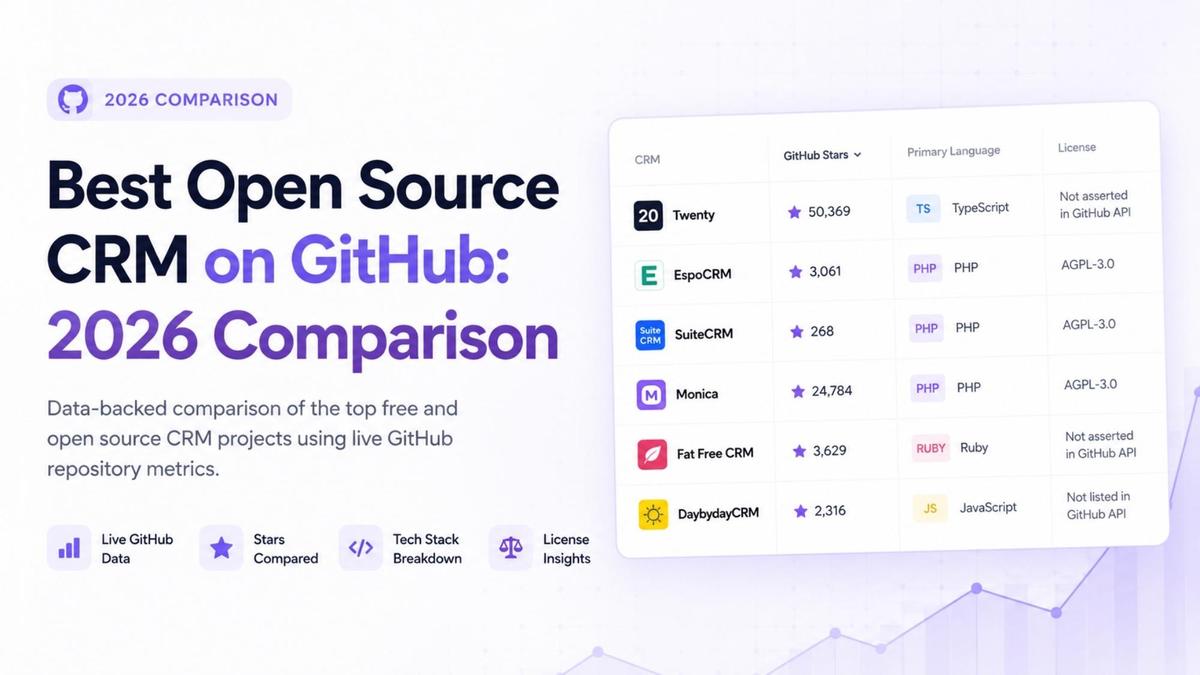
If you search for the best open source CRM on GitHub, the results are usually a mix of GitHub repositories, Reddit threads, and static software roundups.
That is useful, but it is not enough.
A CRM can look good in a listicle and still be a bad operational choice. It might have a lot of stars but weak recent activity. It might be technically impressive but too developer-heavy for a small sales team. It might be free to download but expensive to maintain.
That is why we built the GitHub CRM Index: a living index of CRM repositories, activity, stars, forks, language, and project signals.
This guide turns that index into a practical 2026 comparison of free and open source CRM projects on GitHub.
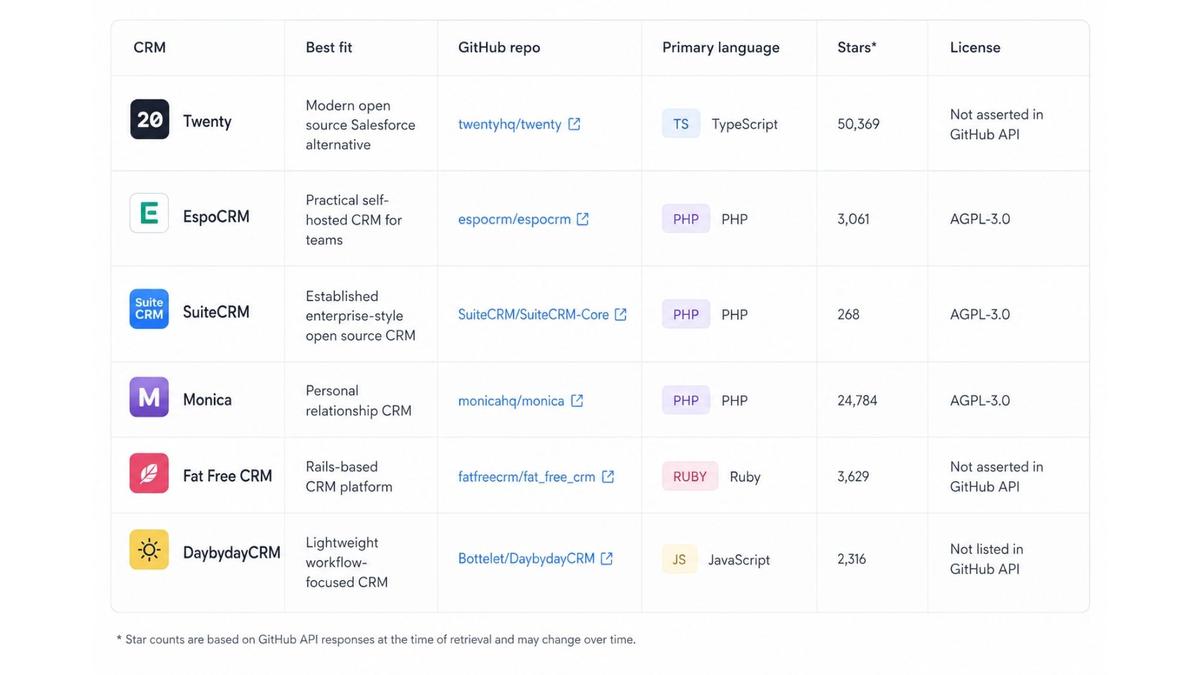
Quick Answer: Best Open Source CRM Projects on GitHub
If you want the short version:
Why GitHub Is the Real CRM Shortlist
Most CRM comparisons start with vendor pages, review sites, or affiliate roundups.
Those can be helpful, but open source CRM selection is different. You are not only choosing a feature set. You are choosing a codebase, a community, a deployment model, and a maintenance burden.
GitHub gives you signals that standard CRM comparison pages often miss:
- Is the project still active?
- What language and stack does it use?
- How many people have starred or forked it?
- Are issues piling up?
- Is the repo archived?
- Does the project look like a real CRM or a side project?
- Is it self-host friendly?
For an operator, those signals matter as much as the feature checklist.
If your team is deciding between open source CRM, HubSpot, Zoho, Salesforce, or a custom workflow, start with the repository. Then use product pages and reviews as supporting evidence.
How We Evaluated These CRM Repositories
This comparison uses three layers of evidence:
- GitHub repository data from the public repos and the GitHub CRM Index.
- Search and SERP research from DataForSEO for queries like
crm github,free crm github,best open source crm github, andopen source crm comparison 2026. - LLM and GEO visibility research to see what AI systems cite when asked about free CRM projects on GitHub.
The main criteria:
- Recent repository activity
- Stars and forks
- Primary language and implementation complexity
- Licensing clarity
- Fit for small business, sales teams, or technical teams
- Whether the project appears in search and AI answers
- How likely a team is to maintain it after the initial install
Important caveat: GitHub stars are not a buying decision. They are a signal. A smaller repo with the right feature set and active maintenance can be a better choice than a huge repo that does not fit your team.
1. Twenty: Best Modern Open Source CRM for Developer-Led Teams
Twenty is one of the most visible modern CRM projects on GitHub. Its repo description calls it "the open alternative to Salesforce, designed for AI."
That positioning matters. Twenty is not trying to be a small personal CRM. It is trying to become a modern, extensible CRM platform for teams that want ownership and flexibility.
GitHub signals checked June 18, 2026:
- Repo: twentyhq/twenty
- Stars: 50,369
- Forks: 7,327
- Primary language: TypeScript
- Recent push: June 18, 2026
- Archived: No
Best for:
- Technical teams that want a modern stack
- Startups that want a Salesforce alternative without starting from zero
- Teams comfortable with self-hosting and developer involvement
- Operators who want a CRM that can evolve with AI-forward workflows
Watch-outs:
- It may be heavier than needed for a very small team.
- You still need technical ownership.
- The license was not asserted in the GitHub API response, so verify licensing directly before production use.
If your team has engineering support and wants a modern open source CRM on GitHub, Twenty should be near the top of your shortlist.
2. EspoCRM: Best Practical Self-Hosted CRM
EspoCRM is one of the strongest options if you want a practical, self-hosted CRM with a more traditional CRM feel.
It is not as flashy as Twenty, but it has strong repository signals and a clear open source footprint.
GitHub signals checked June 18, 2026:
- Repo: espocrm/espocrm
- Stars: 3,061
- Forks: 886
- Primary language: PHP
- License: AGPL-3.0
- Recent push: June 18, 2026
- Archived: No
Best for:
- Small and midsize teams that want a self-hosted CRM
- Teams comfortable with PHP-based infrastructure
- Operators who need accounts, contacts, activities, and sales workflows
- Companies that want open source control without building a CRM from scratch
Watch-outs:
- As with any self-hosted CRM, updates, backups, security, and integrations become your responsibility.
- If your team already lives in HubSpot or Salesforce, migration and process design matter more than the install.
EspoCRM is a good fit when you want a real CRM, not just a contact database, and you have enough technical support to maintain it.
3. SuiteCRM: Best Established Open Source CRM
SuiteCRM has been around for years and remains one of the better-known open source CRM projects.
The strength of SuiteCRM is maturity. The tradeoff is that mature CRM systems can feel heavier, especially for teams that want a modern user experience or lightweight setup.
GitHub signals checked June 18, 2026:
- Repo: SuiteCRM/SuiteCRM-Core
- Stars: 268
- Forks: 196
- Primary language: PHP
- License: AGPL-3.0
- Recent push: June 9, 2026
- Archived: No
Best for:
- Teams that want an established open source CRM lineage
- Organizations with more traditional CRM requirements
- Operators who need configurable modules and sales process coverage
- Teams that value maturity over new-stack appeal
Watch-outs:
- Smaller GitHub star count on the core repo does not tell the full SuiteCRM story.
- Implementation can feel heavier than modern alternatives.
- You should evaluate the product ecosystem, documentation, and deployment path, not just the repo.
SuiteCRM is worth evaluating if you want an established CRM system and can support a more traditional implementation.
4. Monica: Best Personal CRM, Not Sales CRM
Monica is often mentioned in CRM lists, but it is important to classify it correctly.
Monica is a personal relationship CRM. It helps people remember details about friends, family, and relationships. That is valuable, but it is not the same as a sales CRM for pipeline, deals, lead routing, or revenue operations.
GitHub signals checked June 18, 2026:
- Repo: monicahq/monica
- Stars: 24,784
- Forks: 2,525
- Primary language: PHP
- License: AGPL-3.0
- Recent push: April 24, 2026
- Archived: No
Best for:
- Personal relationship management
- Individuals who want a self-hosted memory system for relationships
- Non-sales use cases where the goal is remembering people, not managing pipeline
Watch-outs:
- Not the best fit for B2B sales teams.
- Not a replacement for HubSpot, Pipedrive, Salesforce, or a sales CRM.
- High star count can mislead buyers if they do not separate personal CRM from sales CRM.
Monica belongs in an open source CRM GitHub comparison, but it should not be treated as a direct substitute for EspoCRM, SuiteCRM, or Twenty.
5. Fat Free CRM: Best for Rails Teams Exploring CRM Foundations
Fat Free CRM is a Ruby on Rails CRM platform.
It may appeal to teams that want a Rails-based codebase or need a CRM foundation they can inspect and adapt. It is less likely to be the first choice for non-technical operators looking for a turnkey CRM.
GitHub signals checked June 18, 2026:
- Repo: fatfreecrm/fat_free_crm
- Stars: 3,629
- Forks: 1,320
- Primary language: Ruby
- Recent push: April 25, 2026
- Archived: No
Best for:
- Ruby on Rails teams
- Developers studying CRM architecture
- Teams that want a hackable CRM foundation
Watch-outs:
- Less obvious fit for a non-technical sales team.
- Licensing was not asserted in the GitHub API response, so verify directly before production use.
- You should evaluate maintenance, dependencies, and deployment effort before committing.
Fat Free CRM is more of a technical option than an operator-first CRM choice.
6. DaybydayCRM: Best Lightweight Workflow CRM to Evaluate Carefully
DaybydayCRM positions itself as an open source CRM to help track daily workflow.
It has enough activity and stars to be worth reviewing, but it should be evaluated carefully against the needs of your team.
GitHub signals checked June 18, 2026:
- Repo: Bottelet/DaybydayCRM
- Stars: 2,316
- Forks: 768
- Primary language: JavaScript
- Recent push: May 25, 2026
- Archived: No
Best for:
- Teams exploring lightweight open source CRM workflows
- Developers who want to inspect a JavaScript-based CRM project
- Smaller teams willing to evaluate fit hands-on
Watch-outs:
- License was not listed in the GitHub API response.
- It may not have the same ecosystem depth as larger CRM projects.
- Validate installation, documentation, issue activity, and integration paths before using it in production.
DaybydayCRM is worth a look, but it should not be selected on stars alone.
SuiteCRM vs EspoCRM vs Twenty: Which Should You Choose?
If you are comparing the most practical open source CRM options, the shortlist usually comes down to SuiteCRM, EspoCRM, and Twenty.
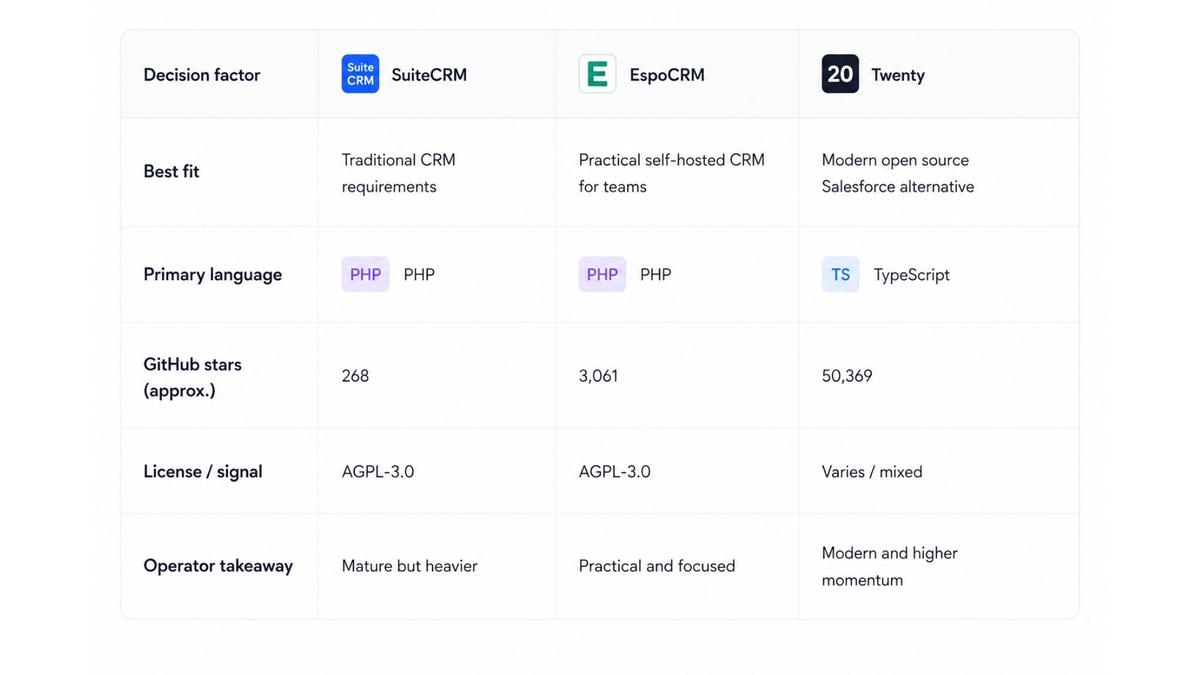
Choose Twenty if you want a modern open source Salesforce alternative and have technical support.
Choose EspoCRM if you want a more straightforward self-hosted CRM that feels closer to a practical business system.
Choose SuiteCRM if you value maturity, traditional CRM depth, and are comfortable with a heavier implementation.
When a Free CRM on GitHub Is the Wrong Choice
Open source is not automatically cheaper.
A free CRM from GitHub can be the right move when:
- You have technical ownership.
- You want control over your data and hosting.
- You need customization beyond what free SaaS tiers allow.
- You are willing to maintain updates, backups, and security.
- You understand the tradeoff between software cost and operational cost.
It can be the wrong move when:
- No one owns deployment or maintenance.
- Your team needs speed more than control.
- Sales reps need a familiar interface tomorrow.
- You need native email, sequences, reporting, and integrations without custom work.
- The business would be better served by HubSpot, Zoho, Pipedrive, or Salesforce.
If you are choosing between open source CRM and a free SaaS CRM, the real question is not "Which one is free?"
The real question is: Who will own the system after launch?
For teams that need help making that call, All Great Things works on CRM selection, automation, and GTM system buildouts through Fast Projects.
How to Choose an Open Source CRM From GitHub
Use this checklist before you install anything:
- Check recent activity. Has the repo been pushed recently?
- Check the issue backlog. Are issues being resolved or ignored?
- Review the license. Do not assume a repo is safe for your use case.
- Check the primary language. Can your team support PHP, TypeScript, Ruby, or JavaScript?
- Look for install documentation. If setup is unclear, production support will be worse.
- Map your CRM process first. Contacts, companies, deals, activities, reporting, automations.
- Decide who owns maintenance. CRM is infrastructure, not a one-time tool install.
- Compare against free SaaS tiers. Sometimes HubSpot or Zoho is the more practical first step.
This is also why we keep the GitHub CRM Index separate from this article. The index is for ongoing repository tracking. This guide is for decision-making.
Best Open Source CRM on GitHub: Final Recommendations
For most teams in 2026:
- Best modern open source CRM: Twenty
- Best practical self-hosted CRM: EspoCRM
- Best established open source CRM: SuiteCRM
- Best personal CRM: Monica
- Best Rails-based CRM foundation: Fat Free CRM
If you are just starting your research, begin with the GitHub CRM Index. Then use this guide to narrow the shortlist based on your team, stack, and operating model.
If you already know you need CRM automation, workflow design, or help choosing between open source and commercial tools, start with our CRM & Workflow Automation hub or review our HubSpot automation guide.
FAQ
What is the best open source CRM on GitHub in 2026?
For a modern developer-led team, Twenty is the strongest GitHub-native option in this comparison. For a practical self-hosted CRM, EspoCRM is a strong choice. For a more established traditional CRM, evaluate SuiteCRM.
Is there a free CRM on GitHub worth using?
Yes, but "free" does not mean zero cost. Open source CRM projects like EspoCRM, SuiteCRM, and Twenty can be worth using if your team can handle hosting, updates, backups, integrations, and maintenance.
What is the best self-hosted open source CRM?
EspoCRM is a strong practical self-hosted option. SuiteCRM is worth evaluating if you need a more established CRM system. Twenty is compelling if you want a modern stack and have technical resources.
Is Monica a sales CRM?
Not really. Monica is better understood as a personal relationship CRM. It is useful for remembering people and relationships, but it is not a direct replacement for a sales pipeline CRM.
Should I choose open source CRM or HubSpot?
Choose open source CRM if you value control, self-hosting, and customization and have technical ownership. Choose HubSpot, Zoho, Pipedrive, or Salesforce if speed, built-in integrations, reporting, and user adoption matter more than code ownership.
How do I compare CRM GitHub repositories?
Look at recent activity, stars, forks, issues, license, primary language, installation docs, and product fit. Then compare that to your operating needs. The GitHub CRM Index is designed to make that first pass faster.